Circleci Ci + Consider Clearing Entrypoint/command Values and Try Again.
Using Environment Variables

 Cloud Server v3.x Server v2.ten
This document describes using environment variables in CircleCI in the following sections:
- Secrets masking
- Renaming orgs and repositories
- Environment variable usage options
- Setting an environment variable in a beat out command
- Setting an surroundings variable in a pace
- Setting an environment variable in a job
- Setting an surround variable in a context
- Setting an surround variable in a project
- Setting an surroundings variable in a container
- Injecting environment variables with API v2
- Injecting environment variables with API v1
- Congenital-in surround variables
Overview
There are several means to use environment variables in CircleCI to provide variety in scope and potency level. Environment variables are governed by an order of precedence, depending on how they are set, allowing control at each level in your configuration.
To add private keys or surreptitious environment variables for use throughout your private projection, use the Surround Variables page under Project Settings in the CircleCI application. The variable values are neither readable nor editable in the app after they are ready. To modify the value of an environment variable, delete the electric current variable and add together it again with the new value.
Private environment variables enable you to store secrets safely even when your project is public. Refer to the Building Open Source Projects page for associated settings information.
Employ Contexts to further restrict admission to surroundings variables. Contexts are set from the Organization Settings in the CircleCI application. For more information about controlling access to env vars with Contexts, refer to the Restricting a Context documentation.
Secrets masking
Secrets masking is not currently available on cocky-hosted installations of CircleCI server
Secrets Masking is practical to environment variables set within Project Settings or under Contexts. Surroundings variables may hold project secrets or keys that perform crucial functions for your applications. Secrets masking provides added security inside CircleCI by obscuring environment variables in the chore output when echo or print are used.
The value of the surroundings variable volition non exist masked in the build output if:
- the value of the environment variable is less than 4 characters
- the value of the surroundings variable is equal to one of
true,True,falseorFake
Annotation: Secrets Masking will only prevent the value of the environment variable from actualization in your build output. Invoking a bash shell with the -x or -o xtrace options may inadvertantly log unmasked secrets (please refer to Using Shell Scripts).
If your secrets announced elsewhere, such equally test results or artifacts, they will non be masked. In add-on, the value of the environment variable is still attainable to users debugging builds with SSH.
Renaming orgs and repositories
If you discover you need to rename an org or repo that yous have previously hooked up to CircleCI, best practise is to follow these steps:
- Rename org/repo in VCS.
- Head to the CircleCI application, using the new org/repo proper name, for example,
app.circleci.com/pipelines/<VCS>/<new-org-name>/<project-proper noun>. - Confirm that your programme, projects and settings take been transferred successfully.
- You are then complimentary to create a new org/repo with the previously-used name in your VCS, if desired.
Notation: If y'all practise non follow these steps, it is possible that you may lose access to your org or repo settings, including environment variables and contexts.
Environment variable usage options
CircleCI uses Bash, which follows the POSIX naming convention for environment variables. Valid characters include letters (majuscule and lowercase), digits, and the underscore. The first grapheme of each surround variable must be a letter.
Lodge of precedence
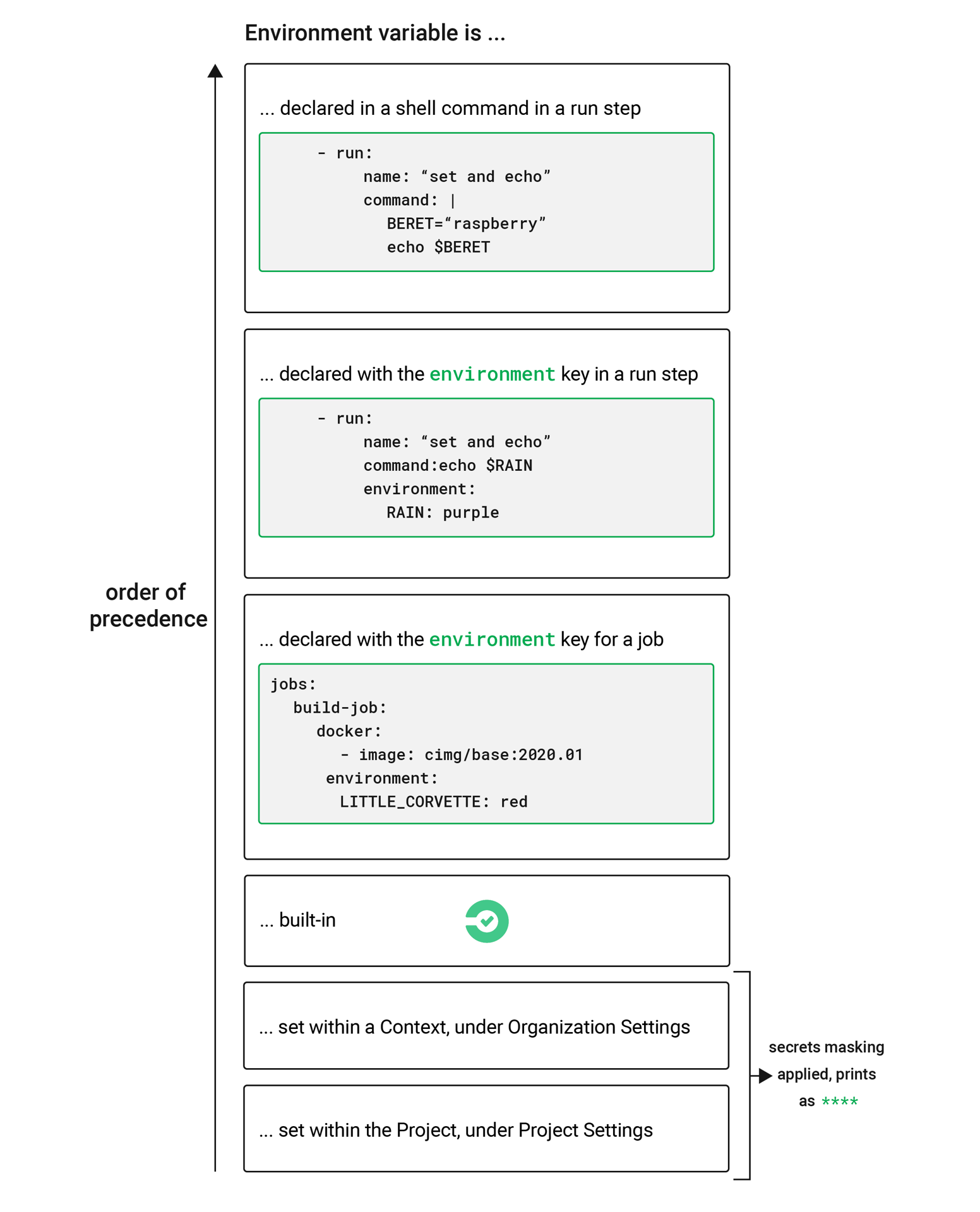
Environment variables are used co-ordinate to a specific precedence club, as follows:
- Environment variables declared inside a shell command in a
runstep, for exampleFOO=bar make install. - Surroundings variables declared with the
environskey for arunstep. - Environment variables set with the
surroundingskey for a job. - Special CircleCI environment variables defined in the CircleCI Built-in Environs Variables section of this document.
- Context environment variables (assuming the user has admission to the Context). See the Contexts documentation for instructions.
- Project-level environs variables set on the Project Settings folio.
Environment variables alleged within a vanquish command run stride, for example FOO=bar make install, will override surroundings variables declared with the environment and contexts keys. Environment variables added on the Contexts page will take precedence over variables added on the Project Settings folio.
Notes on security
Practise non add secrets or keys inside the .circleci/config.yml file. The total text of config.yml is visible to developers with access to your project on CircleCI. Store secrets or keys in project or context settings in the CircleCI app. For more than information, encounter the Encryption department of the Security certificate.
Running scripts within configuration may expose secret surround variables. See the Using Beat out Scripts document for best practices for secure scripts.
Example configuration of environment variables
Consider the example config.yml beneath:
version : ii.1 jobs : # bones units of work in a run build : docker : # utilise the Docker executor # CircleCI node images available at: https://hub.docker.com/r/circleci/node/ - paradigm : cimg/node:17.2.0 auth : username : mydockerhub-user password : $DOCKERHUB_PASSWORD # context / project UI env-var reference steps : # steps that comprise the `build` chore - checkout # cheque out source code to working directory # Run a step to setup an environment variable # Redirect MY_ENV_VAR into $BASH_ENV - run : name : " Setup custom environs variables" command : repeat 'consign MY_ENV_VAR="FOO"' >> $BASH_ENV - run : # impress the name of the branch nosotros're on proper noun : " What co-operative am I on?" command : repeat ${CIRCLE_BRANCH} # Run some other step, the same equally higher up; note that you lot can # invoke environment variable without curly braces. - run : proper name : " What branch am I on now?" command : echo $CIRCLE_BRANCH - run : name : " What was my custom environs variable?" command : echo ${MY_ENV_VAR} - run : name : " Print an env var stored in the Project" command : echo ${PROJECT_ENV_VAR} - run : name : " Print an env var stored in a Context" control : repeat ${CONTEXT_ENV_VAR} workflows : # a single workflow with a single task called build build : jobs : - build : context : Testing-Env-Vars The in a higher place config.yml demonstrates the following:
- Setting custom environment variables
- Reading a built-in surround variable that CircleCI provides (
CIRCLE_BRANCH) - How variables are used (or interpolated) in your
config.yml - Secrets masking, applied to environment variable set in the projection or inside a Context.
When the to a higher place config runs, the output looks like this. Notice the env var stored in the Project is masked, and displays equally ****:
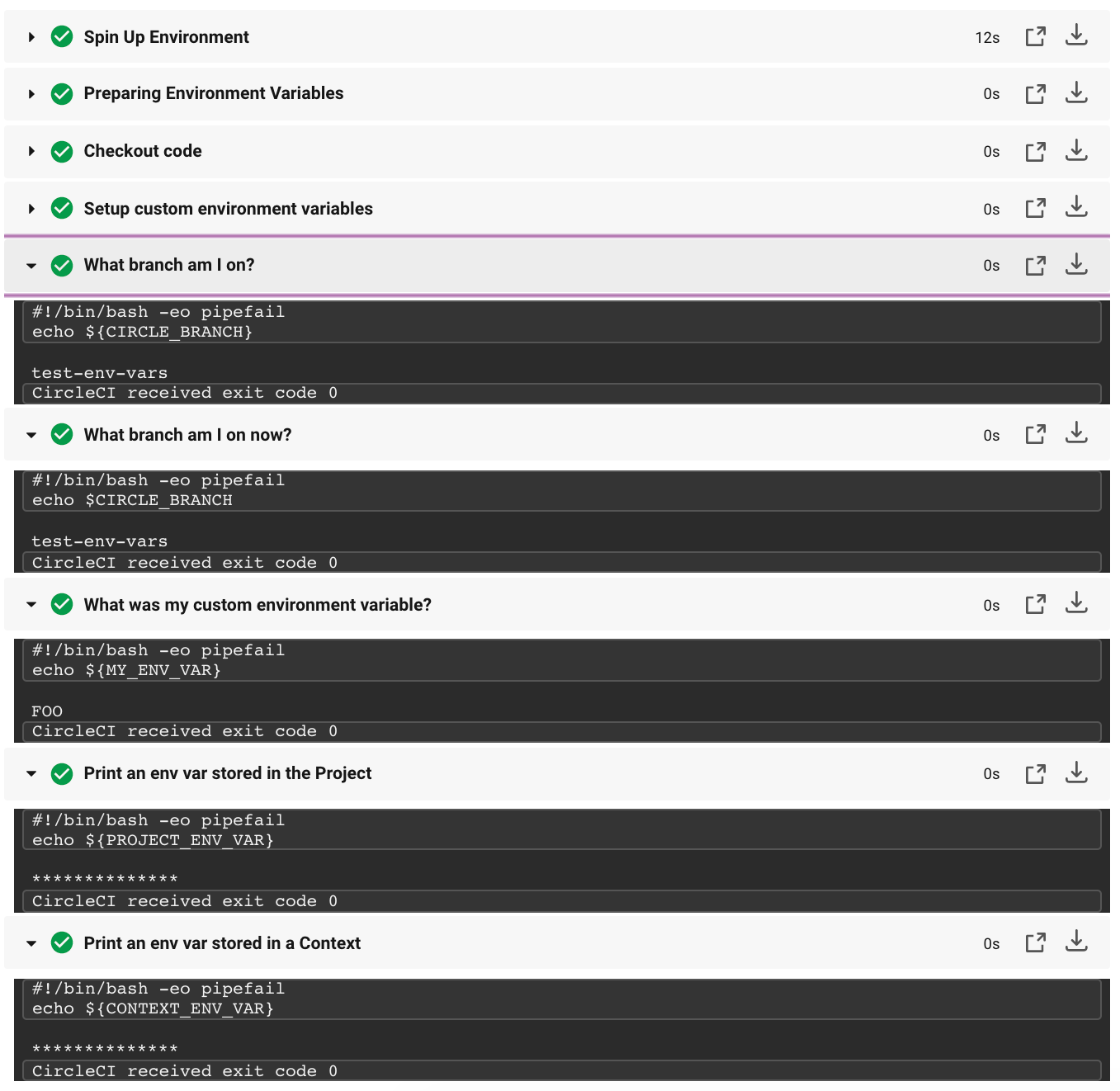
Discover there are two similar steps in the above epitome and config - "What branch am I on?". These steps illustrate two different methods to read environs variables. Note that both ${VAR} and $VAR syntaxes are supported. You lot can read more than nigh shell parameter expansion in the Bash documentation.
Using parameters and bash environment
In general, CircleCI does not support interpolating environment variable into build config. Values used are treated as literals. This tin can crusade issues when defining working_directory, modifying PATH, and sharing variables across multiple run steps.
An exception to this rule is the docker image section in society to back up Private Images.
In the example below, $ORGNAME and $REPONAME will not be interpolated.
working_directory : /go/src/github.com/$ORGNAME/$REPONAME Using version: 2.ane config, you lot can reuse pieces of config across your config.yml. By using the parameters announcement, you can interpolate (or, "laissez passer values") into reusable commands jobs and executors:
version : 2.1 jobs : build : parameters : org_name : type : string default : my_org repo_name : blazon : string default : my_repo docker : - image : cimg/go:1.17.3 auth : username : mydockerhub-user password : $DOCKERHUB_PASSWORD # context / project UI env-var reference steps : - run : echo "project directory is go/src/github.com/<< parameters.org_name >>/<< parameters.repo_name >>" workflows : my_workflow : jobs : - build : org_name : my_organization repo_name : project1 - build : org_name : my_organization repo_name : project2 For more information, read the documentation on using the parameters announcement.
Another possible method to interpolate values into your config is to use a run step to export environment variables to BASH_ENV, every bit shown below.
steps : - run : name : Setup Environment Variables control : | repeat 'export PATH=$GOPATH/bin:$PATH' >> $BASH_ENV echo 'export GIT_SHA1=$CIRCLE_SHA1' >> $BASH_ENV In every footstep, CircleCI uses fustigate to source BASH_ENV. This means that BASH_ENV is automatically loaded and run, assuasive y'all to use interpolation and share environment variables beyond run steps.
Note: The $BASH_ENV workaround simply works with bash. Other shells probably won't work.
Tall Linux
An image that's based on Tall Linux (like docker), uses the ash shell.
To use environment variables with fustigate, but add these 2 parameters to your job.
version : 2.1 jobs : build : shell : /bin/sh -leo pipefail environment : - BASH_ENV : /etc/contour Setting an surround variable in a shell control
While CircleCI does non back up interpolation when setting environs variables, it is possible to fix variables for the current beat past using BASH_ENV. This is useful for both modifying your PATH and setting surroundings variables that reference other variables.
version : 2.1 jobs : build : docker : - image : smaant/lein-flyway:2.vii.ane-4.0.3 auth : username : mydockerhub-user countersign : $DOCKERHUB_PASSWORD # context / projection UI env-var reference steps : - run : name : Update PATH and Define Environment Variable at Runtime command : | echo 'export PATH=/path/to/foo/bin:$PATH' >> $BASH_ENV echo 'export VERY_IMPORTANT=$(true cat important_value)' >> $BASH_ENV source $BASH_ENV Note: Depending on your beat out, you may take to append the new variable to a shell startup file like ~/.tcshrc or ~/.zshrc.
For more information, refer to your beat's documentation on setting environs variables.
Setting an environment variable in a footstep
To set an environs variable in a step, utilise the environment key.
version : 2.ane jobs : build : docker : - epitome : smaant/lein-flyway:2.7.1-4.0.3 auth : username : mydockerhub-user password : $DOCKERHUB_PASSWORD # context / project UI env-var reference steps : - checkout - run : name : Run migrations command : sql/docker-entrypoint.sh sql # Environment variable for a single control shell environment : DATABASE_URL : postgres://conductor:@localhost:5432/conductor_test Note: Since every run step is a new beat out, environment variables are non shared across steps. If you lot demand an environment variable to be accessible in more than one step, consign the value using BASH_ENV.
Setting an surroundings variable in a job
To set up an surround variable in a chore, use the environment primal.
version : 2.1 jobs : build : docker : - image : buildpack-deps:trusty auth : username : mydockerhub-user password : $DOCKERHUB_PASSWORD # context / project UI env-var reference surroundings : FOO : bar Note: Integers longer than 6 digits will be converted to an exponential number. To avoid this, store them as a string instead (i.e. "1234567").
Setting an surround variable in a context
-
In the CircleCI awarding, go to your organisation settings by clicking the link in the left paw navigation.
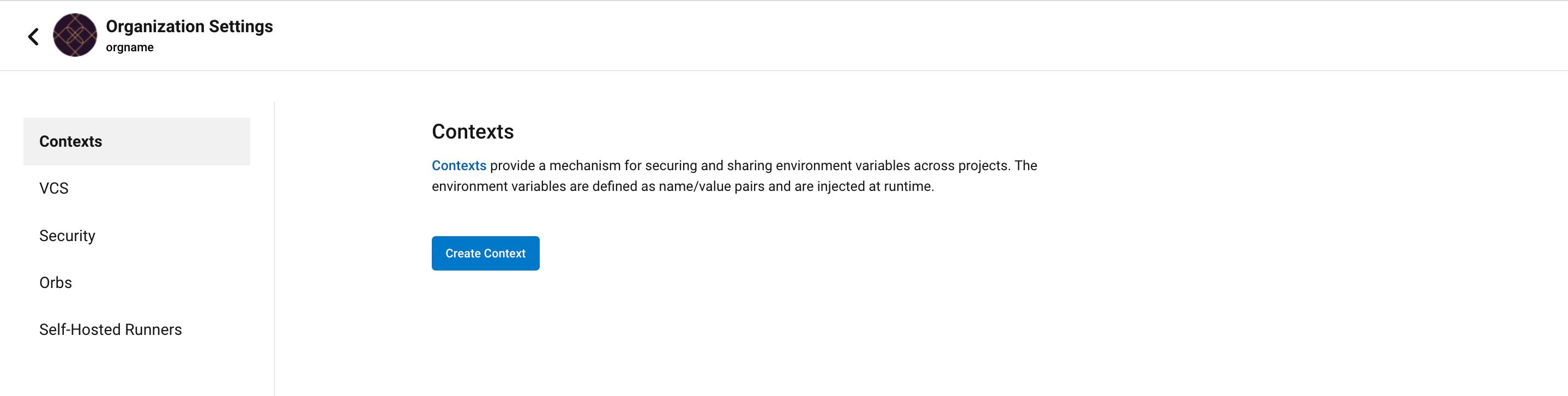
- Select the Context you want to acquaintance your environment variable with, or create a new one by clicking the Create Context button.
- Click Add Surround Variable and enter a name and value.
- Use your new surround variable in your
.circleci/config.ymlonce the context is added under the workflows key, as follows:
version : two.one workflows : test-env-vars : jobs : - build : context : my_context_name # has an env var called MY_ENV_VAR jobs : build : docker : - image : cimg/base:2021.11 auth : username : mydockerhub-user countersign : $DOCKERHUB_PASSWORD # context / project UI env-var reference steps : - checkout - run : name : " echo an env var that is role of our context" command : | repeat $MY_ENV_VAR Creating a context allows yous to share surround variables beyond multiple projects, and control who has admission. For more information, see the Contexts documentation.
Setting an surroundings variable in a projection
-
In the CircleCI application, go to your project's settings by clicking the gear icon on the Pipelines page, or the three dots on other pages in the awarding.

- Click on Environment Variables.
- Add new variables by clicking the Add together Variable push button and enter a proper noun and value.
- Use your new environment variables in your
.circleci/config.ymlas follows:
version : 2.1 workflows : test-env-vars : jobs : - build jobs : build : docker : - image : cimg/base:2021.eleven auth : username : mydockerhub-user countersign : $DOCKERHUB_PASSWORD # context / project UI env-var reference steps : - checkout - run : name : " echo an env var that is office of our project" command : | repeat $MY_ENV_VAR # this env var must be set up inside the project Once created, surround variables are hidden and uneditable in the application. Changing an environs variable is only possible by deleting and recreating it.
Setting an surroundings variable in a container
Surroundings variables can also be set for a Docker container. To do this, use the environment key.
Note: Environment variables set in this mode are non available to steps run within the container, they are just available to the entrypoint/command run by the container. Past default, CircleCI will ignore the entrypoint for a job's primary container. For the primary container's environment variables to be useful, yous will demand to preserve the entrypoint. For more information, see the adding an entrypoint section of the Custom Images guide.
version : ii.1 jobs : build : docker : - image : <image>:<tag> auth : username : mydockerhub-user countersign : $DOCKERHUB_PASSWORD # context / projection UI env-var reference # environment variables available for entrypoint/command run by docker container surroundings : MY_ENV_VAR_1 : my-value-i MY_ENV_VAR_2 : my-value-2 The post-obit example shows separate environs variable settings for the primary container image (listed first) and the secondary or service container image.
Note: While difficult-coded environment variable values volition be passed on correctly to the secondary or service container, contexts or project specific environment variables will not be interpolated for not-chief containers.
version : 2.ane jobs : build : docker : - image : <epitome>:<tag> auth : username : mydockerhub-user password : $DOCKERHUB_PASSWORD # context / project UI env-var reference environment : MY_ENV_VAR_1 : my-value-ane MY_ENV_VAR_2 : my-value-2 - epitome : <prototype>:<tag> auth : username : mydockerhub-user countersign : $DOCKERHUB_PASSWORD # context / project UI env-var reference surround : MY_ENV_VAR_3 : my-value-3 MY_ENV_VAR_4 : my-value-4 Encoding multi-line environs variables
If yous are having difficulty calculation a multiline surround variable, employ base64 to encode it.
$ echo "foobar" | base64 --wrap =0 Zm9vYmFyCg == Store the resulting value in a CircleCI environment variable.
$ echo $MYVAR Zm9vYmFyCg == Decode the variable in any commands that utilise the variable.
$ echo $MYVAR | base64 --decode | docker login -u my_docker_user --password-stdin Login Succeeded Note: Non all command-line programs have credentials in the same way that docker does.
Injecting surround variables with API v2
Pipeline parameters can be used to pass variables using the CircleCI API v2.
A pipeline can exist triggered with specific parameter values using the API v2 endpoint to trigger a pipeline. This can be washed past passing a parameters fundamental in the JSON packet of the POST torso.
The case beneath triggers a pipeline with the parameters described in the to a higher place config case (NOTE: To pass a parameter when triggering a pipeline via the API the parameter must be declared in the configuration file.).
curl -u ${ CIRCLECI_TOKEN }: -X POST --header "Content-Blazon: application/json" -d '{ "parameters": { "workingdir": "./myspecialdir", "paradigm-tag": "4.8.2" } }' https://circleci.com/api/v2/project/:project_slug/pipeline Important Pipeline parameters are not treated as sensitive data and must not be used by customers for sensitive values (secrets). You can find this sensitive information in Project Settings and Contexts.
Read more in the Pipeline Variables guide.
Injecting surroundings variables with API v1
Build parameters are environment variables, therefore their names take to run across the post-obit restrictions:
- They must contain simply ASCII messages, digits and the underscore character.
- They must not begin with a number.
- They must contain at least ane graphic symbol.
Aside from the usual constraints for environment variables at that place are no restrictions on the values themselves and are treated as unproblematic strings. The gild that build parameters are loaded in is not guaranteed and then avoid interpolating i build parameter into another. It is all-time do to ready build parameters as an unordered list of contained surround variables.
Important Build parameters are non treated as sensitive data and must not exist used past customers for sensitive values (secrets). Y'all tin discover this sensitive data in Project Settings and Contexts.
For example, when you laissez passer the parameters:
{ "build_parameters" : { "foo" : "bar" , "baz" : 5 , "qux" : { "quux" : one }, "listing" : [ "a" , "listing" , "of" , "strings" ] } } Your build volition see the environment variables:
consign foo = "bar" consign baz = "v" export qux = "{ \" quux \" : 1}" export listing = "[ \" a \" , \" listing \" , \" of \" , \" strings \" ]" Build parameters are exported equally environment variables inside each task's containers and can be used past scripts/programs and commands in config.yml. The injected surround variables may be used to influence the steps that are run during the job. It is of import to notation that injected environment variables volition not override values defined in config.yml nor in the project settings.
You might want to inject environment variables with the build_parameters key to enable your functional tests to build against different targets on each run. For example, a run with a deploy pace to a staging environment that requires functional testing against unlike hosts. It is possible to include build_parameters by sending a JSON body with Content-type: application/json as in the post-obit example that uses fustigate and curl (though yous may as well use an HTTP library in your language of choice).
{ "build_parameters" : { "param1" : "value1" , "param2" : 500 } } For case using curl
curl \ --header "Content-Type: application/json" \ --header "Circumvolve-Token: $CIRCLE_TOKEN " \ --data '{"build_parameters": {"param1": "value1", "param2": 500}}' \ --request POST \ https://circleci.com/api/v1.i/projection/github/circleci/mongofinil/tree/master In the above example, $CIRCLE_TOKEN is a personal API token.
The build will run across the surroundings variables:
export param1 = "value1" export param2 = "500" Offset a run with the Mail service API call, encounter the new build section of the API documentation for details. A Mail service with an empty trunk will kickoff a new run of the named branch.
Built-in environment variables
Built-in environment variables are exported in each job and can be used for more circuitous testing or deployment.
| Variable | Type | Value |
|---|---|---|
CI | Boolean | true (represents whether the current environment is a CI environment) |
CIRCLECI | Boolean | true (represents whether the current environment is a CircleCI environment) |
CIRCLE_BRANCH | String | The name of the Git co-operative currently beingness built. |
CIRCLE_BUILD_NUM | Integer | The number of the current job. Job numbers are unique for each task. |
CIRCLE_BUILD_URL | String | The URL for the electric current job on CircleCI. |
CIRCLE_JOB | String | The name of the electric current job. |
CIRCLE_NODE_INDEX | Integer | For jobs that run with parallelism enabled, this is the alphabetize of the electric current parallel run. The value ranges from 0 to (CIRCLE_NODE_TOTAL - 1) |
CIRCLE_NODE_TOTAL | Integer | For jobs that run with parallelism enabled, this is the number of parallel runs. This is equivalent to the value of parallelism in your config file. |
CIRCLE_OIDC_TOKEN | String | An OpenID Connect token signed by CircleCI which includes details nearly the electric current task. Available in jobs that use a context. |
CIRCLE_PR_NUMBER | Integer | The number of the associated GitHub or Bitbucket pull request. Only available on forked PRs. |
CIRCLE_PR_REPONAME | String | The proper noun of the GitHub or Bitbucket repository where the pull request was created. Only available on forked PRs. |
CIRCLE_PR_USERNAME | String | The GitHub or Bitbucket username of the user who created the pull request. Simply available on forked PRs. |
CIRCLE_PREVIOUS_BUILD_NUM | Integer | The number of previous builds on the current branch. |
CIRCLE_PROJECT_REPONAME | Cord | The name of the repository of the current project. |
CIRCLE_PROJECT_USERNAME | String | The GitHub or Bitbucket username of the current projection. |
CIRCLE_PULL_REQUEST | String | The URL of the associated pull request. If there are multiple associated pull requests, i URL is randomly called. |
CIRCLE_PULL_REQUESTS | Listing | Comma-separated list of URLs of the electric current build's associated pull requests. |
CIRCLE_REPOSITORY_URL | String | The URL of your GitHub or Bitbucket repository. |
CIRCLE_SHA1 | Cord | The SHA1 hash of the terminal commit of the current build. |
CIRCLE_TAG | String | The proper name of the git tag, if the current build is tagged. For more information, see the Git Tag Job Execution. |
CIRCLE_USERNAME | String | The GitHub or Bitbucket username of the user who triggered the pipeline (only if the user has a CircleCI account). |
CIRCLE_WORKFLOW_ID | Cord | A unique identifier for the workflow instance of the current job. This identifier is the same for every job in a given workflow case. |
CIRCLE_WORKFLOW_JOB_ID | String | A unique identifier for the electric current job. |
CIRCLE_WORKFLOW_WORKSPACE_ID | String | An identifier for the workspace of the current job. This identifier is the same for every task in a given workflow. |
CIRCLE_WORKING_DIRECTORY | String | The value of the working_directory key of the electric current job. |
CIRCLE_INTERNAL_TASK_DATA | String | Internal. A directory where internal information related to the job is stored. We practise non document the contents of this directory; the data schema is discipline to change. |
CIRCLE_COMPARE_URL | String | Deprecated. The GitHub or Bitbucket URL to compare commits of a build. Bachelor in config v2 and below. For v2.i we will introduce "pipeline values" as an alternative. |
For a full list of available built-in data encounter the Project Values and Variables guide.
Run into also
Contexts Go along environs variables private with secret masking
huddlestonthatock.blogspot.com
Source: https://circleci.com/docs/2.0/env-vars/

Mag-post ng isang Komento for "Circleci Ci + Consider Clearing Entrypoint/command Values and Try Again."